– The Tea Journal –
Why We Blend Tea
A leaf can be remarkable on its own. So can a flower, a herb, or a spice. Blending begins with a different question: what might they become together?
Behind the Blends
|
About 8 minute read
|
September 2026
More Than Adding Things Together
At first glance, blending tea seems straightforward.
Choose some tea.
Add a flower.
Perhaps an herb or a spice.
Mix everything together.
Make a cup.
And sometimes, that cup might even be quite good.
But thoughtful blending asks for something more.
It asks us to consider not only what each ingredient tastes like on its own, but what happens when it has to share the cup with everything else.
Will one ingredient overwhelm another?
Will two flavors complement each other?
Does the blend have somewhere to begin and somewhere to go?
What happens to the aroma?
The color?
The mouthfeel?
And perhaps most importantly:
Why is this ingredient here?
That last question changes everything.
Every Ingredient Needs a Reason
Imagine adding rose petals to a blend.
They are beautiful.
That alone can make them tempting.
But beauty in the dry blend does not necessarily mean they belong in the finished cup.
What do they contribute when brewed?
Perhaps a floral aroma.
Perhaps a gentle flavor.
Perhaps visual beauty.
Perhaps they support another ingredient so subtly that the drinker may never identify the rose itself.
All of those can be legitimate reasons.
But simply having rose petals available isn’t one.
Thoughtful blending is as much about what we leave out as what we put in.
An ingredient should have a purpose.
Sometimes that purpose is obvious.
Sometimes it is almost invisible.
An ingredient doesn’t have to announce itself to matter. Sometimes its most important job is helping another ingredient become more completely itself.
Building a Cup
One way to think about a blend is as a small structure.
Some ingredients provide the foundation.
A black tea might give the cup body and depth. Rooibos can bring warmth and a naturally rounded character. A green tea may provide freshness and a vegetal backbone.
Then other ingredients begin shaping what happens above that foundation.
Citrus can bring brightness.
Mint can create a cooling finish.
Ginger can introduce warmth.
Hibiscus can add tartness and vivid color.
Chamomile can soften a blend with its gentle floral character.
Flowers may contribute aroma before their flavor is ever consciously noticed.
But these aren’t fixed roles.
The same ingredient can behave very differently depending on what surrounds it.
Peppermint beside ginger isn’t quite the same peppermint as peppermint beside chamomile.
Hibiscus at the center of a blend can be bold and commanding. Used sparingly, it may simply lift everything around it.
Blending is not only about knowing ingredients.
It is about understanding relationships between ingredients.
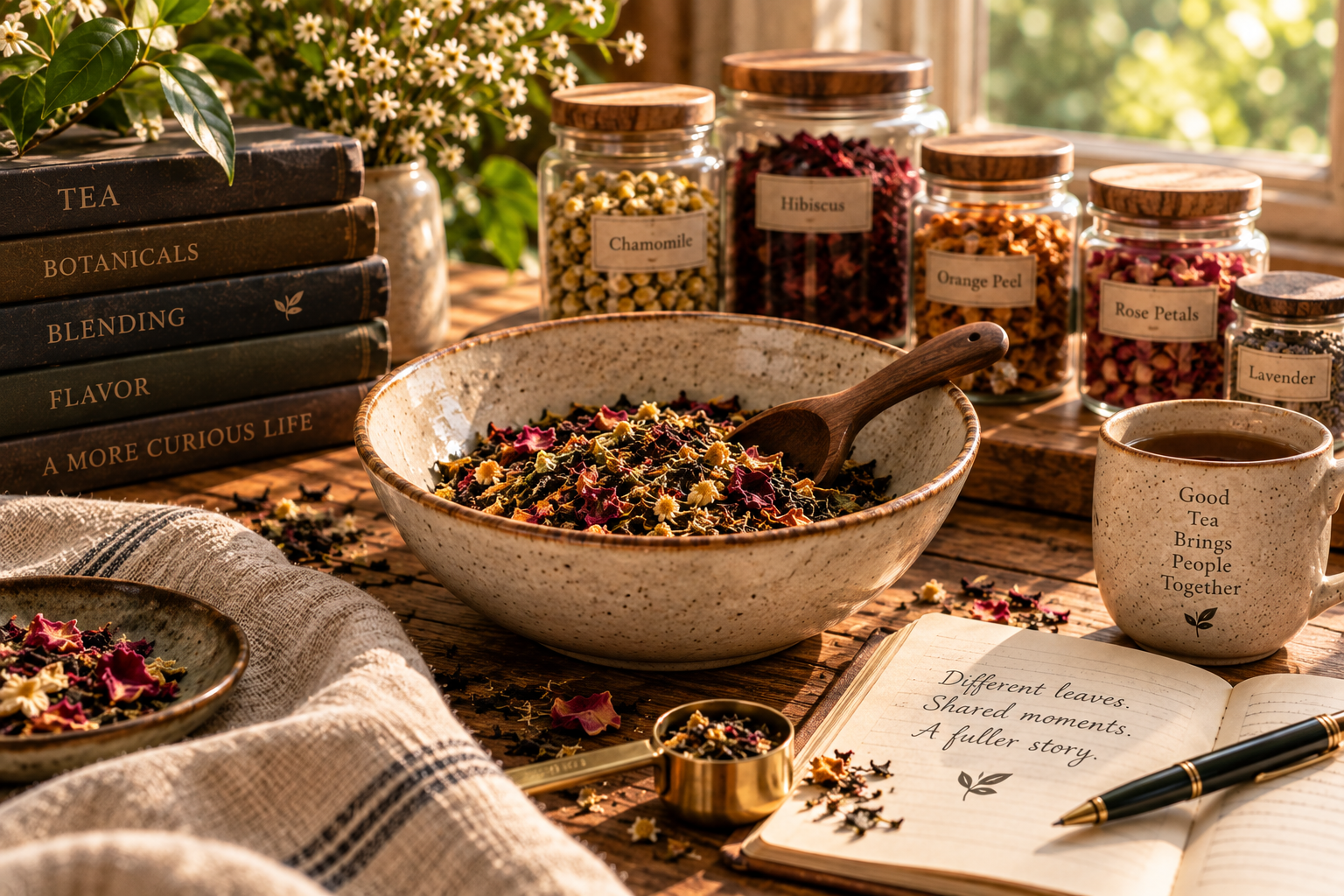
Blending is all about the ingredients talking to each other.
Balance Does Not Mean Equal
There is an easy mistake to make when thinking about balance.
We sometimes imagine that a balanced blend should allow every ingredient to be tasted equally.
But that would be a very particular—and often rather crowded—kind of cup.
Balance can be quieter than that.
One ingredient may lead.
Another may appear in the middle.
Something else might wait until the finish.
A botanical that makes up only a small portion of the dry blend may have an enormous aromatic presence. Another present in much greater quantity may quietly provide body without ever becoming the flavor someone names first.
So balance isn’t equality.
It is proportion.
The ingredients don’t all need the same size part.
They need the right part.
Sometimes Opposites Belong Together
Some of the most interesting blends contain ingredients that seem to pull in different directions.
Cooling mint and warming ginger.
Soft florals and tart hibiscus.
Delicate tea beside bright citrus.
Comfort beside freshness.
At first, these combinations can seem contradictory.
But contrast can create movement in a cup.
A sip may begin one way and finish another.
Warmth can follow freshness.
Tartness can lift something soft.
A bright aroma can lead into a deeper body.
This is where blending begins to feel less like assembling a list of flavors and more like creating an experience through time.
Because we don’t actually taste a cup all at once.
We encounter it.
First aroma.
First sip.
Middle.
Finish.
Aftertaste.
Then another sip, informed by the one before it.
A blend has room to move.
The Recipe Is Only the Beginning
Eventually, a blend needs numbers.
How much of each ingredient?
Five percent?
Twenty?
Half the blend?
Those proportions matter enormously, and recording them carefully is what allows a successful blend to become repeatable.
But a recipe on paper cannot tell us whether the blend actually works.
For that, we have to brew it.
Then taste it.
Then adjust it.
Perhaps the ginger is louder than expected.
Perhaps an aroma that seemed beautiful in the dry ingredients disappears entirely after brewing.
Maybe the color surprises us.
Maybe something we expected to dominate becomes strangely quiet.
Sometimes the first attempt works remarkably well.
Often it doesn’t.
So we change something.
And brew it again.
The dry blend tells us what we made. The brewed cup tells us whether it worked.
Listening to the Cup
This may be our favorite part of blending.
Once the water is poured, the recipe stops being theoretical.
We notice the dry aroma first, and then how that aroma changes after the ingredients meet hot water.
We watch the color develop.
We smell the finished infusion.
Then we taste.
What arrives first?
What follows?
What remains after the sip?
How does the tea feel in the mouth?
Does it seem heavy or light?
Bright or soft?
Does anything feel out of place?
And sometimes we ask a different kind of question:
How does this cup make you feel?
Not because a tea must produce a prescribed emotion.
Quite the opposite.
We’re interested in the character of the experience.
Does it feel like something you would drink while reading?
Does it make you want to step outside?
Does it seem contemplative?
Bright?
Comforting?
Restless?
Familiar?
There are no correct responses.
Sometimes the most useful answer is one we never anticipated.
When the Blend Surprises the Blender
There is a wonderful moment that occasionally happens during development.
You begin with an idea of what a blend is supposed to become.
You choose ingredients.
Adjust proportions.
Brew.
Taste.
Change something.
Brew again.
And somewhere along the way, the blend develops a personality you didn’t plan.
Perhaps two ingredients create an unexpected contrast.
Perhaps a flavor appears at the finish that changes the entire experience.
Perhaps someone tastes it without knowing what you intended and describes something completely different—and better.
At that point, we have a choice.
Force the blend back toward the original idea.
Or listen.
We prefer listening.
Because blending requires intention, but it also requires enough humility to recognize when the cup has found somewhere more interesting to go.
Knowing When to Stop
Adding another ingredient is easy.
Removing one can be harder.
There is always another possibility.
Perhaps a little cinnamon.
Maybe some citrus peel.
What if we added a flower?
Could it use more mint?
At some point, experimentation can become noise.
A blend does not become more thoughtful simply because it contains more ingredients.
Sometimes the thing that makes everything finally work is taking something away.
And eventually there comes a cup where nothing seems to be asking for correction.
That doesn’t necessarily mean every person will love it.
Taste is far too personal for that.
It simply means the blend has become what it was trying to be.
Then we stop.
A Story You Can Drink
At Ink In Amber, we often talk about blends as having stories.
That doesn’t mean we begin with a clever name and force ingredients into it.
The story develops alongside the tea.
Sometimes it begins with an idea.
Sometimes with an ingredient.
Sometimes with a feeling we want to explore.
And sometimes the story doesn’t become clear until we’ve tasted the blend several times and realized what has been sitting in front of us all along.
Eventually, the recipe, the sensory experience, the name, and the story should feel as though they belong to one another.
If they don’t, we aren’t finished.
That is why blending, for us, isn’t simply the act of combining tea and botanicals.
It is a conversation between intention and discovery.
We bring an idea to the table.
The ingredients answer.
We make adjustments.
The cup answers again.
And somewhere in that conversation, if we’re fortunate, something emerges that none of the ingredients could have said quite the same way alone.
That is why we blend tea.
Continue the Story
Every Blend Has a Story
Before an Ink In Amber blend receives its name, there is something we listen for. This is how a cup becomes a story.
Read more…
From Leaf to Cup: What is Tea?
Black, green, white, and oolong teas can look and taste remarkably different – yet they begin with the same remarkable plant.
Read more…