
– The Tea Journal –
From Leaf to Cup: What Is Tea?
Black, green, white, and oolong can look and taste remarkably different—yet their stories begin with the same plant.
Tea & the Leaf
|
About 8 minute read
|
September 2026
One Plant, Many Cups
Place a delicate white tea beside a grassy green tea, a fragrant oolong, and a dark black tea and you could easily assume you were looking at the leaves of several different plants.
Brew them, and the differences become even greater.
One cup may be pale and gentle.
Another fresh and vegetal.
Another floral, creamy, roasted, or wonderfully complex.
Another deep amber, malty, brisk, or bold.
And yet, beneath all those differences is a rather wonderful fact:
They are all tea.
More specifically, they all begin with the leaves of Camellia sinensis.
So if the plant is the same, how can the cups become so different?
The answer begins after the leaf is picked.
Meet Camellia sinensis
Camellia sinensis is an evergreen plant in the camellia family.
Left to itself, it can grow considerably larger than the neatly trimmed rows we often associate with tea gardens. In cultivation, tea plants are commonly pruned into manageable bushes that make repeated harvesting of young leaves and buds easier.
There are different varieties, cultivars, and local forms of the tea plant, each with characteristics suited to particular climates, growing conditions, processing styles, and desired flavors.
Where the plant grows matters.
So does the soil.
The elevation.
The weather.
The season.
Which leaves are picked.
How they are picked.
And the knowledge of the people growing and processing them.
So saying that all true tea comes from one plant does not mean all tea begins identically.
It means an astonishing amount of diversity exists within one botanical family.
Think of Camellia sinensis as the beginning of the story, not the finished character. Where it grows, which leaves are harvested, and what happens afterward all help determine what eventually reaches the cup.
The Leaf Has Been Picked. Now What?
This is where tea begins its transformation.
Fresh tea leaves contain water, enzymes, aromatic compounds, and many other chemical components. Once the leaves are harvested, tea makers can manipulate them in different ways—allowing them to wilt, bruising or rolling them, heating them, shaping them, drying them, and sometimes roasting or aging them.
The order, duration, and intensity of those steps can dramatically change the finished tea.
One process is particularly important to understand:
Oxidation.
If you’ve ever cut an apple and watched the exposed flesh gradually turn brown, you’ve seen oxidation at work.
Tea is more complicated than an apple, but the comparison gives us a useful starting point. When tea leaves are bruised, rolled, or otherwise disrupted, compounds inside the leaf are exposed to oxygen and enzymatic reactions begin changing them.
Color changes.
Aroma changes.
Flavor changes.
The tea maker can encourage that process, limit it, or stop it with heat.
And suddenly our different cups begin to make more sense.
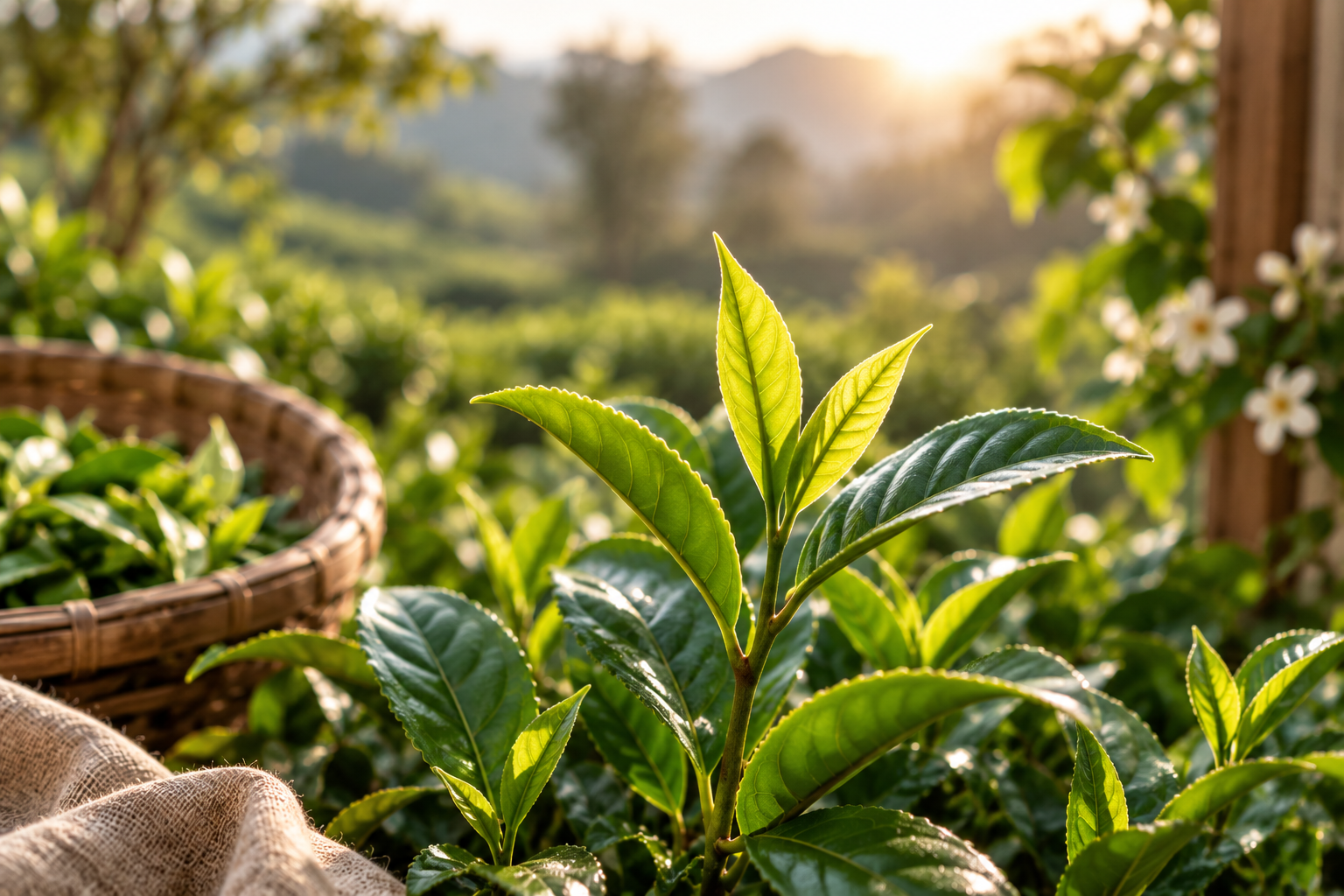
From a simple leaf comes wonderful flavors.
Green Tea: Preserving the Green
Green tea is processed to limit oxidation relatively early.
After harvesting, the leaves are heated—a step often called fixing or kill-green—which deactivates the enzymes responsible for oxidation.
Different tea traditions accomplish this differently.
Chinese green teas are often heated in pans or other hot surfaces, while Japanese green teas are commonly steamed.
Those choices matter.
They contribute to the enormous range found even within the category of green tea: vegetal, grassy, nutty, marine, sweet, toasted, floral, or something in between.
The leaves are then shaped and dried in various ways depending on the tea being made.
The goal isn’t simply to “keep the leaf green.”
It is to capture a particular expression of it.
White Tea: Less Intervention, Not Less Character
White tea is often described as minimally processed.
Young buds and leaves are generally harvested, withered, and dried with comparatively little manipulation.
That sounds simple.
But simple does not mean careless.
Controlling moisture, airflow, temperature, and drying still requires skill, and even relatively gentle processing creates changes within the leaf.
White teas can be delicate and floral, but they can also develop honeyed, fruity, woody, or deeper characteristics depending on the material, processing, and age.
Their quiet appearance can be deceptive.
There can be an extraordinary amount happening in a pale cup.
Black Tea: Letting Oxidation Travel Further
Black tea takes oxidation much further.
After withering, the leaves are rolled, crushed, or otherwise manipulated to encourage oxidation. As that process continues, the leaves darken and their chemistry changes.
Eventually, heat and drying halt the process and stabilize the tea.
The resulting flavors can range enormously.
Malty.
Fruity.
Floral.
Cocoa-like.
Brisk.
Sweet.
Spicy.
Sometimes bold enough to stand comfortably beside milk and sugar; sometimes nuanced enough that adding anything would hide the very qualities someone worked carefully to create.
Interestingly, what much of the English-speaking world calls black tea is often referred to as red tea in Chinese terminology—a reference to the reddish color of the brewed liquor rather than the dark appearance of the dried leaves.
Even the names remind us that tea can be understood from more than one perspective.
Oxidation and fermentation are sometimes used interchangeably when people talk about tea, but they are not the same process. Most black tea is oxidized, not fermented. True microbial fermentation belongs to another fascinating corner of the tea world—one we’ll visit another day.
Oolong: A World Between
Oolong is sometimes described simply as partially oxidized tea.
That is true, but it barely hints at what the category contains.
An oolong may be lightly oxidized, green and floral, with aromas that seem almost impossibly fragrant.
Another may be more heavily oxidized or roasted, producing deeper fruit, honey, mineral, caramelized, or toasted characteristics.
The leaves may be rolled into tight balls or twisted into long strands.
Some are roasted.
Some are not.
Some transform dramatically across repeated infusions.
Calling oolong “between green and black tea” is useful when first learning the categories, but eventually it becomes a little like describing an entire country by saying what lies on either side of it.
Oolong is a world of its own.
And Those Aren’t the Only Possibilities
Once we understand that processing can transform the same plant in different ways, the neat little collection of four tea types begins expanding.
There are yellow teas, produced through specialized processing that shares some characteristics with green tea but includes additional steps.
There are dark teas that undergo microbial fermentation and aging.
There are teas scented with flowers.
Teas smoked over wood.
Teas roasted repeatedly.
Teas compressed into cakes.
Teas aged for years or decades.
And within every broad category are regional traditions, cultivars, processing choices, grades, harvest seasons, and individual makers whose decisions shape the finished leaf.
The deeper you travel into tea, the less useful it becomes to imagine each category as a single flavor.
“Green tea” is not one flavor.
Neither is black tea.
Neither is oolong.
They are enormous families.
The Human Hand in the Cup
It would be easy to tell the story of tea processing as though the leaves simply move through a sequence of mechanical steps.
Picked.
Withered.
Rolled.
Oxidized.
Heated.
Dried.
Finished.
But there are decisions hidden inside every one of those words.
When should the leaves be harvested?
How long should they wither?
How vigorously should they be rolled?
How much oxidation is enough?
When should heat be applied?
How should they be shaped?
At what temperature should they be dried or roasted?
Tea making is agriculture, chemistry, tradition, sensory judgment, and craftsmanship meeting in the same leaf.
Two people can begin with similar material and make very different tea.
That is worth remembering when we hold the finished cup.
Someone made decisions that helped it become what it is.
So What Is Tea?
We began with what seemed like a very simple question.
Tea is a drink made by infusing the leaves of Camellia sinensis in water.
That definition is correct.
But it feels rather incomplete now.
Because between the plant and the cup lies a remarkable chain of events.
A place.
A climate.
A growing season.
A harvest.
A leaf.
A series of choices.
A maker’s knowledge.
Heat, air, water, time, and transformation.
And finally, somewhere far from where that leaf may have grown, someone pours hot water over it.
The leaves open.
The water changes color.
An aroma rises from the cup.
And all of that history becomes something you can hold between your hands.
Perhaps that is one of the reasons tea rewards curiosity so generously.
The closer you look at something seemingly simple, the larger it becomes.
Continue the Story
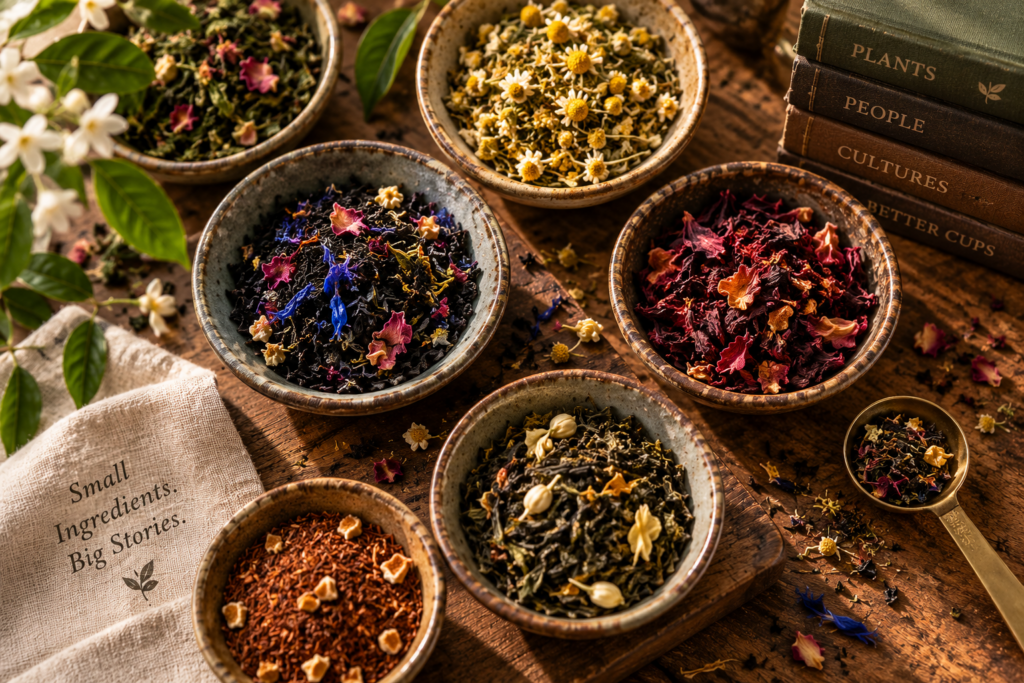
Tea, Tisane, or Herbal Infusion?
We call many things “tea”. Technically, not all of them are. The Distinction leads somewhere surprisingly interesting.
Read more…
Why We Blend Tea
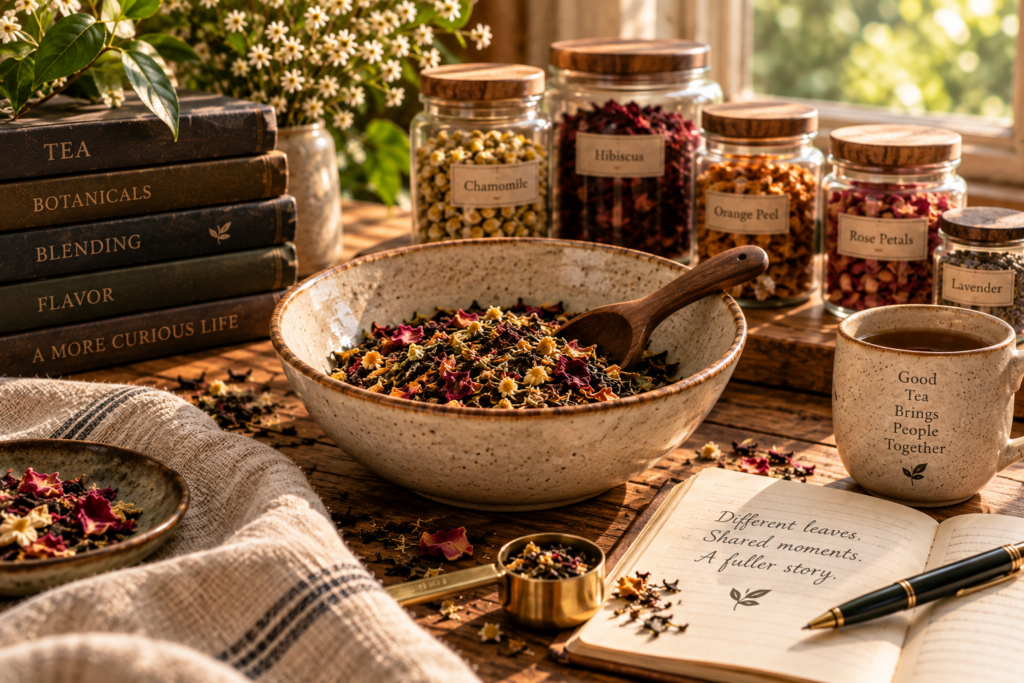
Once we understand what a single leaf can become, what happens when we invite flowers, herbs, spices, and other teas into the cup?
Read more…